
Custom Living Room Entertainment Center: The Complete Guide
A custom entertainment center transforms a plain TV wall into a tailored focal point that fits your space, stores your media, and reflects your style. This guide walks you through every decision—from built-in versus modular designs to sizing, materials, and budget—so you can order with confidence.
Start Your Custom BuildWhy Go Custom? A stock entertainment center rarely fits a wall perfectly. A custom living room entertainment center is measured to your exact space, sized for your TV, and configured around your storage needs. The result is a cleaner look, fewer gaps, and furniture that feels like part of the architecture.
Recommended Custom Living Room Entertainment Centers
⚠️ AFFILIATE DISCLOSURE: This website contains affiliate links. As an affiliate Associate, we earn from qualifying purchases. If you make a purchase through these links, we may receive a small commission at no additional cost to you. Read our full affiliate policy.

Farmhouse 4-Piece Elegant Blue Entertainment Center Wall Unit for TVs Up to 70 Inch, Modern Built in TV Stand with Adjustable Bridge & Shelves, All-in-One Media Console with Drawers & Cable Management
Check price on Amazon
OneBlis 98" Farmhouse TV Stand with 36" Electric Fireplace, Bookshelves, Fits 75" TVs, Entertainment Center with Storage Cabinet, Large Wall Unit Media Console for Living Room, White
Check price on Amazon
Merax Farmhouse Entertainment Center with Bridge for TVs up to 70" | Built-In Wall Design, TV Stand, Adjustable Bridge, Multi-Zone Storage, Cable Management, Adjustable Shelves, Farmhouse Style
Check price on Amazon
Modular Entertainment Center with All-Glass Door Cabinets, 126" Large TV Wall Unit, Media Console with Bookshelves and Arched Tops, Fits 70 Inch TV, Modern White Display Credenza Storage System
Check price on Amazon
YITAHOME 59" TV Stand with Power Outlet & LED Light for 65 Inch TVs, Black | Farmhouse Entertainment Center with Storage Cabinets, Media Console Living Room Furniture
Check price on Amazon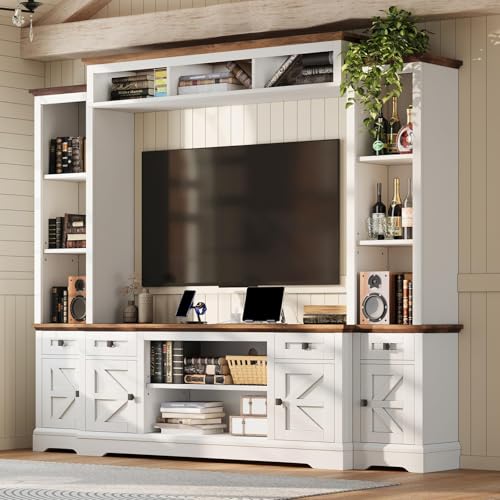
AMERLIFE 98" Farmhouse Wall Unit Entertainment Center with Bookshelf | Large Media Console for TVs up to 75", Rustic TV Cabinet with Power Outlets & Barn Door for Living Room, Off-White
Check price on Amazon
AeasyG 94" Entertainment Center with Bookshelves for TVs up to 70" (White) | Large Wall Unit TV Stand, Modern Wood Media Console with Power Outlet, TV Entertainment Center with Storage for Living Room
Check price on Amazon
Casaottima TV Stand for 65 Inch TV, Entertainment Center, White | Farmhouse Entertainment Center, Power Outlet & LED Light, Storage Cabinets, Media Furniture for Living Room, Bedroom
Check price on AmazonWhat Makes an Entertainment Center "Custom"?
A custom living room entertainment center is furniture or millwork designed around your specific room, television, and storage habits rather than pulled from a standard size chart. That can mean a fully built-in wall unit fabricated by a carpenter, a modular system you configure piece by piece, or a semi-custom wall unit ordered to your dimensions. What separates them from mass-market consoles is fit: the unit spans your wall, accommodates your exact TV size, and hides the cables and components you actually own.
If you are still weighing ready-made options against bespoke designs, our built-in wall unit entertainment center guide covers the structural side, while the entertainment center with media storage overview helps you plan component capacity. For most homeowners, the decision comes down to three paths: full custom millwork, modular semi-custom systems, or a large stock unit styled to look built-in.
Types of Custom Living Room Entertainment Centers
Before you request quotes, identify which category matches your home and budget. Each type carries different installation requirements and price points.
Built-In Wall Units
Built-ins are fabricated on site to meet your walls, ceiling, and any architectural features like fireplaces or windows. They offer the most seamless look and the greatest storage volume. Expect professional installation and a longer lead time, typically four to eight weeks. A basement built-in entertainment center is a common project for homeowners who want a dedicated media room without sacrificing floor space.
Modular and Semi-Custom Systems
Modular systems let you combine base cabinets, towers, bridges, and shelves into a configuration that fits your wall. They are easier to assemble than true built-ins and can be reconfigured if you move. A 3-piece wall unit entertainment center is a popular starting point for living rooms because it balances storage with an open, airy feel. For long walls, a long entertainment center with storage keeps the proportions balanced.
Freestanding and Floating Custom Looks
If you rent or prefer flexibility, a freestanding unit or floating wall panel can deliver a custom aesthetic without permanent construction. A floating wall TV panel with LED lights creates a modern media wall, while a freestanding TV stand for flat screens remains movable. These options pair well with a console table for under wall mounted TV when you want the TV mounted and the storage below.
How to Size a Custom Entertainment Center
Sizing is the single most important step. Get it wrong and your custom unit will look cramped or oversized, no matter how good the craftsmanship is.
Match the Unit to Your TV
A common rule is that the entertainment center should be wider than the television. Our guide on whether a TV stand should be wider than the TV explains the proportions in detail. As a starting point, add at least 10 to 12 inches on each side of the screen for visual balance. For large displays, a entertainment center to fit 75-inch TV or an entertainment wall unit for 85-inch TV gives you realistic width and height targets.
Measure Height, Depth, and Clearance
Account for the TV's mounted height, the depth of your AV components, and ventilation space. If you plan to wall-mount the TV above the unit, check our guidance on 55-inch TV wall mount height from floor and the 65-inch TV wall mount 90-degree swivel option for rooms with multiple viewing angles. A ceiling TV mount that moves up and down is another solution when floor space is tight.
Plan for Components and Cable Management
Count every device: cable box, streaming player, game console, receiver, and router. A custom design should include ventilated bays, adjustable shelves, and a cable channel. If you want doors to hide equipment, an entertainment center with cabinet doors or entertainment center with locking doors keeps things tidy and secure.
Materials, Finishes, and Style Options
The material you choose affects durability, price, and how well the unit blends with your living room. Painted MDF offers a smooth, uniform finish and is the most budget-friendly for built-ins. Plywood with hardwood veneer provides a premium look and better moisture resistance. Solid wood is the most durable and repairable option, but it costs more.
Popular style directions include a wood entertainment center with shelves for a warm, traditional feel, a white entertainment center with shelves for a bright and airy room, and a sliding barn door entertainment center for farmhouse character. If you want a mid-century look, a mid-century modern style media console or a mid-century modern solid wood TV stand can be adapted into a larger custom wall configuration.
Adding a Fireplace to Your Custom Entertainment Center
An integrated fireplace turns a media wall into a year-round gathering spot. Electric fireplaces are the most flexible because they require no venting and can be inserted into a custom cabinet. Options range from an electric fireplace insert for TV stand to a full electric fireplace entertainment stand. For a stone look, consider a faux stone electric fireplace TV stand.
If you prefer a linear design, a linear electric fireplace with TV above creates a clean horizontal line. Homeowners with larger walls often choose a 70-inch wall mounted electric fireplace or a 72-inch electric fireplace with mantel. For rooms without electricity access at the wall, a ventless propane fireplace freestanding unit is an alternative, and a propane fireplace entertainment center combines heat with storage.
Coordinating Tables, Lighting, and Decor
A custom entertainment center looks best when the surrounding furniture shares its lines and finish. A matching media console and coffee table set creates visual rhythm, and a coffee table end table and TV stand set covers the full seating area. For a cohesive farmhouse look, a farmhouse TV stand and coffee table set is a strong choice, while a matching TV stand coffee and end tables grouping works for transitional rooms.
Lighting softens the hard lines of a large wall unit. A traditional floor lamp for living room adds warm ambient light, and tall floor candle holders for fireplace add height and texture beside a fireplace wall. If your layout includes a fireplace and TV together, our living room with fireplace and TV ideas guide covers arrangement options.
Custom Solutions for Tricky Room Layouts
Not every living room has a wide, flat wall. Corner units solve awkward geometry: a solid wood corner entertainment center or a corner entertainment center with hutch uses dead space efficiently. For smaller rooms, a small square living room layout with TV shows how to position a custom unit without blocking traffic.
Multi-function walls are increasingly popular. A built-in entertainment center with desk creates a work-from-home zone in the living room, while an entertainment center with side shelves adds display space without a full wall build. For bedrooms, a entertainment center for master bedroom or a small entertainment center for bedroom scales the concept down.
What Does a Custom Entertainment Center Cost?
Custom pricing varies widely by material, size, and whether you hire a carpenter. As a realistic range for planning, semi-custom modular systems typically cost between $800 and $2,500, while full built-in millwork for a living room wall generally runs from $2,500 to $8,000 or more depending on complexity, finish, and integrated features such as fireplaces or lighting.
To control costs, prioritize the elements you see and touch most: the finish, the door fronts, and the hardware. Hidden structural components can use more economical materials. If you are comparing options, our large entertainment center with shelves and small entertainment center with shelves pages show how shelf count and width affect price. A tall entertainment center with storage costs more than a low console because of the added material and stability requirements.
Before you order, confirm return policies, lead times, and whether assembly or installation is included. For freestanding pieces, a free standing TV stand for flat screens remains the simplest path. If you need flexibility for a very large display, a mobile TV stand for 80-inch flat screen or a freestanding TV stands for flat screens unit can be moved as your layout changes.
Your Custom Entertainment Center Checklist
Before you finalize your order, confirm these points:
- Measure the wall width, ceiling height, and available depth.
- Confirm the unit is wider than the TV and tall enough for your components.
- Plan ventilation and cable routing for every device.
- Choose a finish that matches your existing trim, flooring, or furniture.
- Decide whether the fireplace, lighting, or desk integration is worth the added cost.
- Verify lead time, delivery, and installation before paying a deposit.
A well-planned custom living room entertainment center is a long-term investment. Take the time to size it correctly and choose materials that suit your lifestyle, and it will serve as the anchor of your living room for years.