
Freestanding Ventless Propane Fireplace: The Complete Buying Guide
Discover how to choose the right ventless propane fireplace for your home. Learn about BTU output, safety features, placement rules, and installation requirements before you buy.
Why this guide matters: A freestanding ventless propane fireplace offers the warmth and ambiance of a traditional hearth without the cost and complexity of a chimney or exterior vent. But ventless technology comes with specific trade-offs—indoor air quality considerations, room size requirements, and varying local regulations. This guide walks you through everything you need to know to make a confident, informed purchase.
What Is a Freestanding Ventless Propane Fireplace?
A freestanding ventless propane fireplace is a self-contained heating appliance that burns liquid propane gas without requiring a chimney, flue, or exterior vent. Unlike traditional fireplaces that send exhaust outdoors, ventless units are engineered to combust gas cleanly enough that the byproducts—primarily water vapor and trace amounts of carbon dioxide—are released directly into the room [citation:5][citation:11]. The "freestanding" designation means the unit is a complete piece of furniture, typically including a mantel, firebox, and log set, rather than an insert that goes into an existing fireplace opening. These units are popular in living rooms, basements, and cabins where running a vent is impractical or too expensive.
How Ventless Propane Fireplaces Work
Ventless propane fireplaces use a precision-engineered burner that mixes propane with room air in exact proportions to achieve near-complete combustion. Because propane delivers roughly 2,516 BTU per cubic foot—more than twice the energy density of natural gas [citation:1]—these units produce substantial heat from a relatively small fuel supply. A built-in Oxygen Depletion Sensor (ODS) continuously monitors room oxygen levels and automatically shuts off the gas if oxygen drops below a safe threshold [citation:5][citation:11]. Many models also feature millivolt control systems that operate without electricity, making them valuable during power outages [citation:4].
Key Features to Evaluate Before Buying
BTU Output & Heating Capacity
Freestanding ventless propane fireplaces typically range from 20,000 to 32,000 BTU. A 30,000+ BTU unit can heat up to 1,500 square feet in a well-insulated space [citation:9]. Choose a unit sized to your room—oversized fireplaces waste fuel and can make small spaces uncomfortable.
Safety Systems
Every legal ventless unit includes an ODS (Oxygen Depletion Sensor) that shuts off the burner if oxygen levels fall. Look for additional safety features like flame failure devices, overheat switches, and tilt switches [citation:7]. A CO detector in the same room is a non-negotiable safety requirement [citation:1].
Ignition Type
Millivolt (standing pilot) ignition works without electricity and is ideal for cabins or power-outage backup. Electronic ignition is more fuel-efficient for daily use but requires a power source. Battery-assisted piezo ignition offers a middle ground [citation:7].
Fuel Conversion Flexibility
Some models are dual-fuel convertible between propane and natural gas. If you might move or switch fuel sources, a convertible unit adds long-term value. Otherwise, order the propane-specific model upfront [citation:1].
Mantel & Finish
Freestanding units come with furniture-grade mantels in finishes like walnut, cherry, or white. The mantel defines the fireplace's visual weight in your room—choose a finish that complements your existing furniture and décor.
Clearance Requirements
Ventless fireplaces require specific clearance from walls, ceilings, and combustible materials. A typical unit needs at least 42 inches of clearance to the ceiling [citation:7]. Check the manufacturer's listing before committing to a placement.
Ventless vs. Vented Propane Fireplaces
Understanding the difference between ventless and direct-vent propane fireplaces is the single most important decision you'll make. Direct-vent units are sealed systems that draw combustion air from outside and exhaust byproducts outdoors through a coaxial pipe [citation:8][citation:11]. They are legal in virtually all jurisdictions and have no indoor air quality impact. Ventless units are cheaper to buy and install, deliver nearly 100% of their heat into the room, and can go almost anywhere—but they release moisture and trace combustion byproducts indoors, and they are restricted or prohibited in some states and municipalities [citation:6][citation:11].
| Feature | Ventless Propane | Direct-Vent Propane |
|---|---|---|
| Venting Required | None | Exterior wall or roof vent |
| Heat Efficiency | Up to 99% | 70–85% |
| Indoor Air Impact | Adds moisture & trace byproducts | None (sealed system) |
| Installation Cost | Lower | Higher |
| Placement Flexibility | High | Requires exterior wall access |
| Ideal Use | Supplemental zone heat, occasional ambiance | Primary heat, daily use, bedrooms |
Safety Requirements and Legal Restrictions
⚠️ Critical: Check Local Codes Before Buying
Ventless propane fireplaces are not legal everywhere. California prohibits the sale of unvented gas heaters for indoor use. Minnesota and Wisconsin have statewide restrictions or bans. Massachusetts allows them only with a fire department permit, a 40,000 BTU per room cap, and a CO alarm—and never as a primary heat source [citation:11]. Roughly one-third of U.S. states allow ventless units without restriction, while the rest have varying regulations based on room size, altitude, and occupancy type [citation:6]. Always confirm with your local building department before purchasing.
Essential Safety Checklist
- Install a carbon monoxide detector in the same room—EPA guidance suggests wall placement about five feet above the floor [citation:1]
- Never use a ventless fireplace as your sole primary heat source—manufacturers design them for supplemental heating [citation:12]
- Follow the room volume requirement: approximately 50 cubic feet of room volume per 1,000 BTU per hour [citation:11]
- Limit continuous operation to 2–3 hours at a time unless the manufacturer specifies otherwise [citation:10]
- Crack a window slightly during extended use to ensure adequate oxygen and reduce moisture buildup [citation:2]
- Keep children and pets away from the open flame—ventless units do not have glass barriers
- Schedule annual professional inspection of the burner and ODS system
Cost Expectations
Freestanding ventless propane fireplaces are significantly more affordable than their vented counterparts. A complete freestanding unit with a mantel, log set, and remote control typically costs between $800 and $2,500, depending on BTU output, finish quality, and brand [citation:13]. By comparison, direct-vent fireplace installations often run $5,500 or more once venting and labor are included [citation:14]. Operating costs vary with propane prices and usage patterns; propane generally costs more per BTU than natural gas, so if you have access to a natural gas line, a dual-fuel convertible model may be worth considering [citation:1].
Typical price range for a complete freestanding ventless propane fireplace:
$800–$2,500
Installation Requirements
One of the primary advantages of a freestanding ventless propane fireplace is simplified installation. There is no chimney to build, no exterior wall to penetrate, and no vent pipe to route. However, professional installation is still strongly recommended—and in many jurisdictions, required by code. You will need a propane supply line run to the unit's location, proper clearances maintained from combustible materials, and the correct gas pressure (typically 10–12 inches of water column for propane) [citation:4]. A two-stage regulator is essential for safe operation; single-stage barbecue regulators are not appropriate for indoor propane appliances [citation:4]. Budget $300–$800 for professional gas line installation and setup, depending on your home's existing propane infrastructure.
Where to Place Your Freestanding Ventless Fireplace
Freestanding ventless fireplaces work well in living rooms, family rooms, basements, and cabins. They can serve as a focal point that complements an entertainment center or media wall. If you're designing a living room around both a fireplace and a TV, be mindful of heat exposure—ventless units release significant heat upward, which can damage electronics placed directly above. A layout that places the fireplace adjacent to rather than underneath the TV is generally safer. For inspiration on integrating a fireplace with your entertainment setup, explore our guides on fireplace and entertainment center designs and living room layouts with fireplace and TV. If you prefer a wood-burning aesthetic with a similar freestanding profile, our article on freestanding wood-burning fireplaces for indoor use covers that alternative.
Frequently Asked Questions
Can a ventless propane fireplace be used as a primary heat source?
No. Ventless fireplaces are designed for supplemental or zone heating only. Building codes and manufacturer instructions prohibit using them as a primary heat source because of indoor air quality and oxygen depletion concerns. They are ideal for taking the chill off a room or providing backup heat during power outages [citation:12].
How long can I run a ventless propane fireplace at one time?
Most experts recommend limiting continuous operation to 2–3 hours at a time. Some manufacturers specify even shorter intervals. Extended use increases moisture accumulation and the concentration of combustion byproducts in your indoor air [citation:10].
Do I need electricity for a ventless propane fireplace?
Not necessarily. Millivolt-control models use a standing pilot and thermocouple to generate their own power, so they work during outages. Electronic ignition models require a 120V outlet for the ignition system and any blower or thermostat features [citation:4].
How much moisture does a ventless fireplace add to the air?
A typical ventless propane fireplace releases roughly one pint of water vapor per hour of operation [citation:4]. In a dry winter climate this can be a welcome benefit, but in a tightly sealed, already-humid home it can contribute to condensation and mold risk. Proper ventilation during use mitigates this concern.
Are ventless propane fireplaces safe?
When installed and operated according to manufacturer instructions and local codes, ventless fireplaces include multiple safety systems—ODS, flame failure device, and overheat shutoff—that make them safe for supplemental use. The key requirements are adequate room volume, some ventilation, and a working CO detector. Households with asthma, severe allergies, or respiratory conditions may be more sensitive to indoor combustion byproducts and should consider direct-vent or electric alternatives [citation:13][citation:14].
Recommended Freestanding Ventless Propane Fireplaces
⚠️ AFFILIATE DISCLOSURE: This website contains affiliate links. As an affiliate Associate, we earn from qualifying purchases. If you make a purchase through these links, we may receive a small commission at no additional cost to you. Read our full affiliate policy.
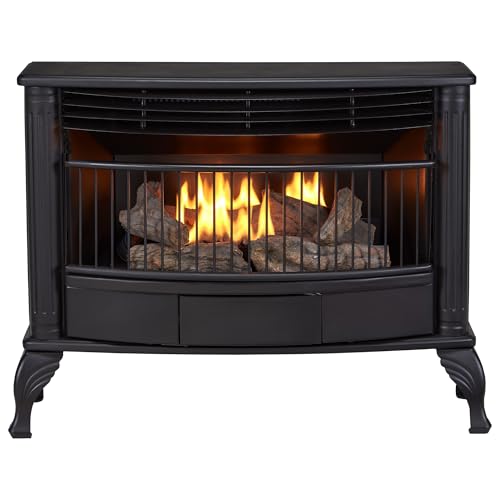
Duluth Forge Ventless Liquid Propane Gas Stove - 25,000 BTU, T-Stat Control, Black Finish - Model# QSL250T
Check price on Amazon
Pleasant Hearth VFS2-PH30DT 30,000 BTU 32" Intermediate Gas vent free stove, Black
Check price on Amazon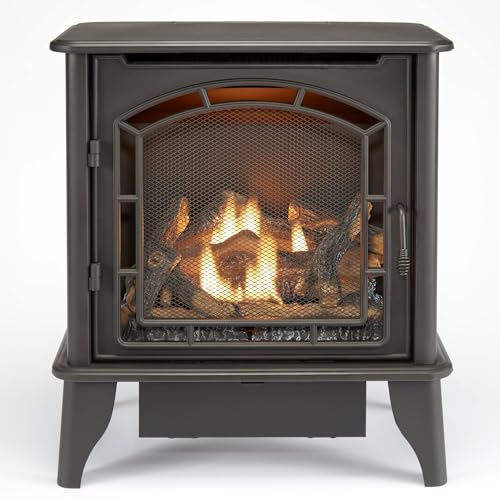
Bluegrass Living Panorama Vent Free Dual Fuel 3-Sided Gas Stove - 23,000 BTU, Remote Control, Black Finish - Model# BTSD23RT
Check price on Amazon
Duluth Forge Dual Fuel Ventless Gas Stove - 26,000 BTU, Remote Control, Matte Black Finish - Model# FDSR25
Check price on Amazon
ProCom Dual Fuel Ventless Gas Fireplace System - 10,000 BTU, T-Stat Control, Apple Spice Finish - Model# FS100T-3AS
Check price on Amazon
ProCom Ventless Dual Fuel Gas Stove - 25,000 BTU, Remote Control, Black Finish - Model# QNSD250RT
Check price on Amazon
Comfort Glow Dual Fuel Walnut Vent Free Gas Fireplace, 26,000 BTU GFD3810T | Natual Gas or Liquid Propane Fireplace, Adjustable Thermostat, Heats up to 900 sq ft Area, Electronic Spark Ignition, ODS
Check price on Amazon
Duluth Forge Dual Fuel Ventless Gas Fireplace Insert - 32,000 BTU, Remote Control - Model# FDF400RT-ZC
Check price on AmazonFinal Considerations
A freestanding ventless propane fireplace delivers the ambiance of a real fire with none of the wood-hauling or chimney-maintenance hassles. It heats efficiently, installs almost anywhere, and costs a fraction of what a direct-vent system requires. The trade-off is indoor air quality—you are choosing to release moisture and trace combustion byproducts into your living space, which is why room size, ventilation, and local codes matter so much. If you have a well-ventilated space, understand the operational limits, and confirm your state allows ventless appliances, a freestanding propane fireplace can be a smart, affordable addition to your home. For a broader look at how a fireplace fits into a complete entertainment setup, browse our guide on TV stands with electric fireplaces or explore entertainment center ideas with fireplace for layout inspiration.