
Chore Chart Board: The Ultimate Guide to Family Organization
Transform your household routine with a chore chart board. Discover the best types, proven strategies, and expert tips to build a system that actually works for your family.
Why Every Family Needs a Chore Chart Board
Managing a household is a full-time job, and keeping everyone on the same page about responsibilities can feel like an endless battle. A chore chart board is more than just a piece of paper on the fridge—it's a powerful organizational tool that brings structure, accountability, and calm to your daily routine. Whether you're a parent trying to teach your children responsibility, a couple splitting household duties, or a roommate group coordinating cleaning schedules, a well-designed chore chart board can be the difference between chaos and harmony.
The concept is simple: a visual board that displays who is responsible for what task, and when it needs to be completed. But the impact is profound. Studies in family psychology consistently show that families who use visual tracking systems like chore charts report lower stress levels, fewer arguments about housework, and children who are more willing to contribute to household tasks. The key is choosing the right board for your family's unique needs and lifestyle.
In this comprehensive guide, we'll walk you through everything you need to know about chore chart boards—from the different types available to age-appropriate task suggestions and expert tips for building a system your family will actually stick with. By the end, you'll be equipped to create a chore routine that reduces your mental load and fosters a sense of teamwork at home.
Recommended Chore Chart Boards
⚠️ AFFILIATE DISCLOSURE: This website contains affiliate links. As an affiliate Associate, we earn from qualifying purchases. If you make a purchase through these links, we may receive a small commission at no additional cost to you. Read our full affiliate policy.

Magnetic Dry Erase Chore Chart - 14.5"x11" Chore Chart for Kids, Teens and Adults - 6.5"x8.5" List Board for Fridge - 6 Extra Fine Point Markers Included - Shipped Flat
Check price on Amazon
Chore Chart for Kids Dry Erase Chore Board ADHD Tools for Kids to Do List Checklist Task Board Routine Chart Planning Board for Fridge with 10 Sliders and Magnetic Marker, White and Blue, 1 Pack
Check price on Amazon
Aleric 4 Pieces Chores Chart for Kids Chore Chart, Sliding Routine Chart to Do List, My Chores RV Checklist Task Planning Board for Kids and Adults, ADHD Tools Routine Visual Schedule Reminder
Check price on Amazon
PigPotParty Acrylic Magnetic Chore Chart for Kids, Large 12x16 Inch, 2 Pack | Clear Dry Erase Fridge Chore and Reward Board for Multiple Kids and Teens; Embedded Magnets; 12 Wet-Erase Markers and Towel
Check price on Amazon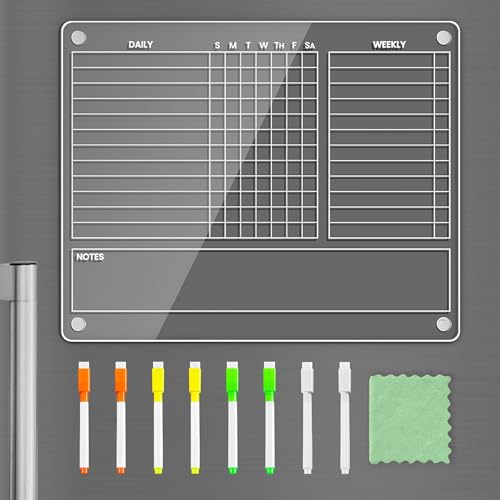
PigPotParty Acrylic Magnetic Chore Chart for Adults, 12x9.5 in Fridge Board | Clear Dry Erase Checklist with Daily, Weekly and Notes; Fits Curved Doors; Embedded Magnets; 8 Wet-Erase Markers and Towel
Check price on Amazon
2 in 1 Bedtime/Morning Routine Chart for Kids Toddlers, Magnetic Chore Chart for Kids, Cute Visual Schedule for Kids Schedule Board for Home, Kids Checklist to Do List ADHD Tools for Kids
Check price on Amazon
Lincia 16x12 in Chore Chart with Dry Erase, 4 Colors, Multiple Kids | 2 in 1 Chore Chart Board for Family Adults Double Side Family, Weekly Calendar Aluminum Frame, 8 Markers Magnetic Dry Eraser
Check price on Amazon
Acrylic Magnetic Chore Chart for Kids, Chore Board, Dry Erase Chore Chart, 12"x9.5" Transparent Erasable Reward Chart for Teens and Adults Chore Checklist with 6 Markers and Towel
Check price on AmazonThe Proven Benefits of Using a Chore Chart Board
Before diving into the types and features of chore chart boards, it's worth understanding why they work so well. When you implement a visual chore system, you're not just organizing tasks—you're building life skills and healthier family dynamics. Here are the key benefits that families consistently report after adopting a chore chart board.
Builds Responsibility in Children
When kids see their name next to a task, they internalize ownership. A chore chart board transforms abstract expectations into concrete, visible responsibilities they can check off and feel proud of.
Reduces Parental Mental Load
Stop being the household's memory keeper. A chore chart board acts as a neutral third party that reminds everyone what needs doing, freeing you from constant nagging and reminding.
Eliminates Arguments About Fairness
When tasks and rotations are clearly displayed, there's no debate about who did what or whose turn it is. The board becomes the authority, not you.
Teaches Time Management
Children and adults alike learn to plan their day around responsibilities. The visual nature of a chore chart board helps users estimate task duration and prioritize.
Creates a Sense of Teamwork
Seeing everyone's contributions displayed together reinforces that running a home is a shared effort. It builds family identity and mutual appreciation.
Provides Visual Satisfaction
There's a genuine psychological reward in moving a magnet, checking a box, or wiping off a task. This immediate feedback loop keeps motivation high over time.
Expert Insight: Child development specialists recommend introducing a chore chart board as early as age 3, starting with simple one-step tasks like putting toys in a bin. The key is matching the complexity of tasks to the child's developmental stage—something we'll cover in detail later in this guide.
Types of Chore Chart Boards: Finding Your Perfect Fit
Not all chore chart boards are created equal. The best choice for your family depends on your space, the ages of your children, your budget, and your preferred method of tracking. Here's a breakdown of the most popular types available today.
Magnetic Chore Chart Boards
These boards use magnetic pieces to represent tasks and names. They're highly durable, easy to rearrange, and excellent for families with younger children who enjoy hands-on interaction. Magnetic boards often come with pre-printed task magnets covering common chores.
$20–$45Dry Erase Chore Chart Boards
Perfect for flexibility, dry erase boards let you write and rewrite tasks as your family's needs change. They're ideal for older children and teens who can handle a more fluid system. Many dry erase boards now come with pre-printed sections for days of the week.
$15–$40Wooden Chore Chart Boards
For families who want an aesthetic that blends with home decor, wooden chore chart boards offer durability and natural beauty. They often feature sliding discs or pegs to mark completed tasks. These are a popular choice for families who keep their chart in a visible living area.
$30–$70Digital & App-Based Chore Charts
For tech-savvy families or those with older children who have smartphones, digital chore charts offer automatic reminders, progress tracking, and even reward point systems. They're excellent for busy families who need flexibility and remote access.
$0–$15/monthWall-Mounted Whiteboard Systems
These larger boards function as command centers for the whole family, combining chore tracking with calendar space, meal planning, and shopping lists. They're ideal for open-concept homes where the kitchen or hallway serves as a central hub.
$25–$60Printable Chore Charts
The most budget-friendly option, printable charts can be customized endlessly and replaced as needed. They work well for short-term use, specific projects, or families who want to test a system before investing in a permanent board.
Free–$10When choosing between these options, consider where the board will live. A magnetic or wooden board works beautifully in a visible family area, while a printable chart might be better for a child's bedroom. If your home has a dedicated command center or mudroom, a wall-mounted whiteboard system can serve multiple organizational purposes simultaneously. For those looking to streamline their living space, consider how a TV stand with storage and shelves or a media unit with storage can incorporate a hidden or displayed chore chart board, keeping organization functional and stylish.
Age-Appropriate Chores: What to Put on Your Chore Chart Board
One of the biggest mistakes families make is assigning tasks that are too difficult or too simple for their children. This leads to frustration, resistance, and abandoned chore systems. The following table provides a general guideline for age-appropriate tasks, but always consider your individual child's maturity and abilities.
| Age Group | Suggested Chores | Chore Chart Board Tips |
|---|---|---|
| Ages 2–3 | Put toys in a bin, throw away diapers, put dirty clothes in hamper, wipe up small spills with help | Use picture-based magnetic boards. Focus on one task at a time and celebrate every completion. |
| Ages 4–5 | Make bed with help, set the table, water plants, feed pets, pick up toys, match socks | A magnetic chore chart board with colorful task magnets works brilliantly at this age. |
| Ages 6–8 | Make bed independently, sort laundry, sweep floors, take out trash, empty dishwasher, pack school bag | Introduce a dry erase board where they can check off tasks. Consider a small reward system. |
| Ages 9–12 | Do laundry, clean bathroom with supervision, prepare simple meals, mow lawn, walk dog, vacuum | A wall-mounted whiteboard system with weekly rotation works well. Include allowance tracking. |
| Ages 13–18 | Cook full meals, clean entire rooms, babysit siblings, run errands, manage their own schedule | Digital chore charts or a shared family calendar board. Focus on independence and life skills. |
Remember that these are guidelines, not strict rules. Some children are ready for certain tasks earlier than others, and some may need more support. The goal is to build competence and confidence gradually. A well-designed chore chart board grows with your child—you might start with a magnetic board with pictures and transition to a dry erase system as they learn to read and write.
How to Build a Chore Chart System That Actually Works
Buying a chore chart board is the easy part. The real challenge is building a system that your family will maintain long-term. Here's a step-by-step approach that has worked for thousands of families.
Step 1: Involve the Whole Family
Before you assign a single task, sit down together and discuss the plan. Ask your children what chores they'd prefer and what rewards would motivate them. When people feel ownership over a system, they're far more likely to participate willingly. This is especially important for older children and teens who may feel resentful of a top-down approach.
Step 2: Start Small and Build Gradually
One of the most common reasons chore systems fail is trying to do too much too soon. If your family has never used a chore chart before, don't launch a comprehensive system with twenty tasks. Start with three or four daily essentials and one weekly task per person. Once those become automatic, add more.
Step 3: Choose the Right Location
Your chore chart board needs to be visible and accessible. The kitchen, hallway, or family room are ideal locations. If your family spends a lot of time in the living room, consider positioning the board near a TV stand with fireplace or entertainment cabinet that anchors the space. The key is placing it where everyone will see it multiple times a day without it becoming visual clutter.
Step 4: Use Clear, Specific Task Descriptions
"Clean your room" is vague and overwhelming. "Put dirty clothes in hamper, make bed, and clear desk" is specific and actionable. Write tasks in a way that defines what "done" looks like. This is especially important for children who are still learning what constitutes a completed task.
Step 5: Establish a Reward and Consequence System
Rewards don't have to be monetary. For younger children, a sticker on a chart or a special privilege (like choosing the movie for family night) can be highly motivating. For older children, a small allowance or extra screen time works well. The key is consistency—if you promise a reward, deliver it. Similarly, if a chore isn't done, the consequence should be predictable and fair.
Pro Tip: Avoid tying all chores to rewards. Some tasks should simply be part of contributing to the family. Use rewards for extra effort or tasks that go above and beyond basic responsibilities. This teaches children that some contributions are unconditional.
Step 6: Review and Adjust Regularly
What works in September may not work in December. As children grow, schedules change, and new responsibilities emerge, your chore chart board should evolve. Set a monthly family meeting to review what's working and what isn't. Celebrate successes and troubleshoot challenges together.
For families with active lifestyles who enjoy spending time outdoors, consider how outdoor living spaces fit into your chore routine. A patio furniture set, for example, might need seasonal cleaning that can be added to a summer chore chart. Similarly, if you have a dedicated home office TV console or TV stand desk, maintaining that workspace organized can be a weekly chore for older children.
Common Chore Chart Board Mistakes to Avoid
Even well-intentioned families run into pitfalls when implementing a chore system. Here are the most common mistakes and how to sidestep them.
- Being inconsistent: If the chart is only enforced on some days, it loses its power. Consistency is the single most important factor in making a chore chart board work.
- Assigning tasks that are too hard: When a child consistently fails at a task, they internalize failure. Break tasks into smaller steps and provide support until they're ready to do it alone.
- Not rotating tasks: Nobody wants to take out the trash every single day forever. Rotate unpleasant tasks fairly so resentment doesn't build.
- Making the chart too complicated: If your chore chart board requires a manual to understand, it's too complex. Simplicity wins.
- Forgetting to update it: A stale chore chart with tasks that no longer apply is worse than no chart at all. Review monthly.
- Using it as punishment: Chore charts should be about building routine and responsibility, not about penalizing children. Keep the tone positive.
Another mistake is failing to consider the visual impact of your chore chart board on your home's decor. If your family room is decorated in a minimalist or mid-century style, a neon-colored plastic chart can feel jarring. Choosing a board that complements your home's aesthetic—whether it's a sleek dry erase board, a warm wooden chart, or a discreet digital display—ensures it feels like a natural part of your space rather than an eyesore. If your living room features a wooden TV stand or a white TV stand, you might choose a chore board that echoes those materials and tones.
Frequently Asked Questions About Chore Chart Boards
What age should I start using a chore chart board with my child?
You can start introducing simple chores as early as age 2 or 3, using a picture-based magnetic board. At this age, the goal is exposure and routine, not perfection. The key is to keep tasks simple, fun, and heavily praised.
Should I pay my children for completing chores?
This is a personal decision. Many experts recommend separating "family contributions" (basic chores everyone does as part of the household) from "extra tasks" that can earn money. This teaches both responsibility and the value of work. Allowance, if given, should not be the only motivation.
How do I get my reluctant child to participate?
Start by involving them in choosing their tasks and rewards. Give them some control over the system. Also, examine whether the tasks are age-appropriate—a child who is consistently refusing may simply be overwhelmed. Break tasks into smaller steps and celebrate each completion.
What's better: a digital chore chart or a physical board?
It depends on your family. Younger children respond better to physical, tactile boards they can interact with. Older children and teens may prefer digital charts with reminders on their phones. Many families use a hybrid approach—a physical board in a central location for daily tasks and a digital tool for older kids' schedules.
How many chores should be on the chart at once?
For younger children, no more than three to four daily tasks. For older children, five to seven is reasonable. The chart should be challenging but not overwhelming. It's better to start with fewer tasks and add more as the routine solidifies.
How do I handle a child who consistently doesn't complete their chores?
First, check if the task is appropriate for their age and ability. Then, review the reward and consequence system—is it meaningful to them? Sometimes a conversation about what's getting in the way is more effective than punishment. Also, ensure that the rest of the family is modeling the behavior you want to see.
Ready to Bring Calm to Your Household?
A chore chart board is one of the simplest, most effective tools for reducing household stress and building a team mentality. Whether you choose a magnetic board for your youngest children, a dry erase system for your tweens, or a digital chart for your teens, the act of making responsibilities visible and shared is transformative. Start small, stay consistent, and watch how a simple board can change the entire rhythm of your home.
Explore Chore Chart Boards →